 2010年成立的中国首家以应对气候变化为目的的全国性公募基金会
联合国气候变化框架公约(UNFCCC)缔约方会议观察员组织
世界自然保护联盟(IUCN)成员单位
全国先进社会组织、4A级基金会
- 中国北京市东城区和平里东街18号
- 8610 84239412
- thjj@thjj.org
首页 > 正文
2014年林业应对气候变化政策与行动白皮书
2020/9/28 17:26:57
2014年林业应对气候变化
政策与行动白皮书
White Paper ― China’s Forestry Policies and Actions
for Addressing Climate Change 2014
国家林业局
2015年9月
State Forestry Administration, P.R.China
September 2015

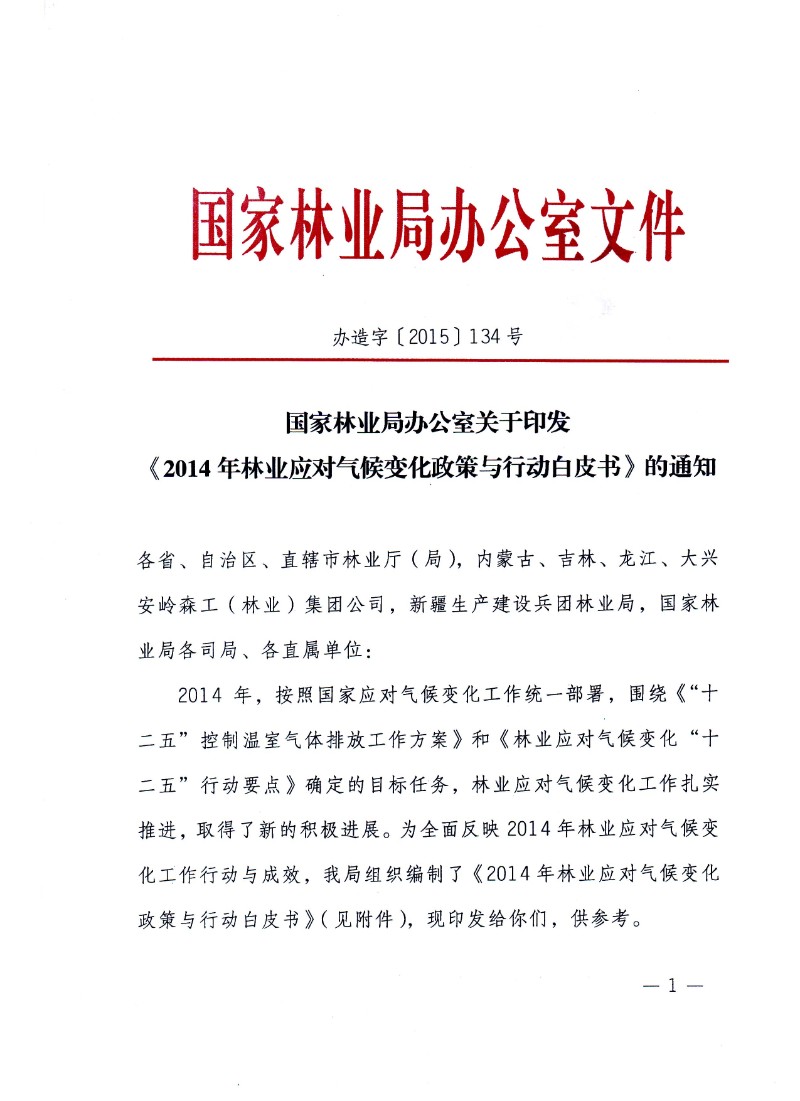


2014年林业应对气候变化
政策与行动白皮书
2014年是全面深化林业改革的开局之年,也是全面推进完成林业“双增”目标的重要一年。按照党中央、国务院决策部署,国家林业局围绕《“十二五”控制温室气体排放工作方案》和《林业应对气候变化“十二五”行动要点》确定的目标任务,扎实推进林业应对气候变化工作取得了新进展,为应对气候变化、建设生态文明作出了新贡献。
一、着力加强林业应对气候变化政策研究,强化宏观指导。深入学习贯彻党中央、国务院有关应对气候变化工作的重要会议和领导同志的重要指示批示精神,按照国家应对气候变化工作的总体部署,结合林业实际,加强政策研究。积极参与《国家应对气候变化规划(2014—2020年)》研究,推进林业相关内容纳入了规划。组织研究提出了2020年后林业增汇减排行动目标,纳入了国家2020年后应对气候变化行动方案。2014年9月,张高丽副总理作为习近平主席特使参加纽约气候峰会并发表重要讲话,明确提出到2030年中国森林蓄积量要显著增加。这是继林业“双增”目标后,中国政府对外又一庄严承诺,进一步彰显了林业在应对气候变化中的重要作用。密切跟踪国家气候变化立法工作进程,配合《森林法》修改,加快推进林业应对气候变化工作法制化。积极参与《单位国内生产总值二氧化碳排放降低目标责任评价考核办法》研究,将年度新增造林合格面积和年度森林抚育合格面积两项指标纳入考核内容,为支撑考核工作、实现控排目标发挥了积极作用。根据国家应对气候变化有关战略和规划要求,组织编制了《林业应对气候变化“十三五”行动要点》和《林业适应气候变化行动方案(2015—2020年)》。制定印发了《2014年林业应对气候变化重点工作安排与分工方案》,明确了六大方面25项重点任务及分工,细化措施,明确时限,狠抓落实。
二、持续加强森林资源培育,努力增加森林碳汇。持续扎实开展造林绿化,深入推进重点生态工程。成功举办中央领导义务植树、共和国部长义务植树、国际森林日等重大活动,加强京津冀蒙林业建设和旱区造林绿化。新一轮退耕还林工程正式启动,安排退耕还林任务500万亩。三北及长江流域等防护林体系建设工程继续稳步推进,出台了退化防护林改造指导意见,启动了退化防护林更新改造试点。京津风沙源治理二期工程和石漠化综合治理工程分别完成林业建设任务367万亩和557万亩。积极推进国家储备林建设,首批划定国家储备林1500万亩。全面加强森林经营,修订颁布森林抚育规程、作业设计规定和检查验收办法,出台了《全国森林经营人才培训计划(2015—2020年)》,加紧编制《全国森林经营规划(2016—2050年)》,稳步推进全国森林经营样板基地建设,全国林地立地质量评价研究取得阶段性成果。2014年,全国共完成造林8324万亩、森林抚育1.35亿亩、义务植树23.2亿株,森林面积和蓄积量持续增加,森林碳汇能力持续增强,为应对气候变化作出了新贡献。第八次全国森林资源清查(2009—2013年)结果表明,相比“双增”目标,森林蓄积量目标已提前完成,森林面积目标已完成约60%。
三、全面加强林业资源管理,努力减少林业排放。落实林地保护利用规划,开展了全国林地“一张图”变更调查及非法侵占林地清理排查和重点国有林区开垦林地清查,进一步强化林地保护管理。深化林木采伐管理改革,东北和内蒙古国有林区停止天然林商业性采伐试点取得突破,天然林资源保护工程区17.32亿亩森林得到有效保护。通过林地管理和采伐改革,努力减少森林资源破坏引起的碳排放。森林防火天地图系统投入使用,进一步提升了林火卫星监测和应急处置能力。2014年,森林火灾次数、受害森林面积、人员伤亡与1999年以来同期平均值相比,分别下降了54.6%、81.3%和18.3%,森林火灾受害率稳定控制在1‰以下。国务院办公厅印发了关于进一步加强林业有害生物防治工作的意见,开展了省级人民政府重大林业有害生物防治目标责任检查考核,启动了全国林业有害生物普查。通过加强林业灾害防控,减少了森林碳排放。林业自然保护区建设、湿地保护、沙化治理取得新进展,既减少林业领域碳排放,又提升了林业适应气候变化能力。2014年,林业国家级自然保护区总数达346个,国家湿地公园总数达569处,新增国家沙漠公园32处、沙化土地封禁保护补助试点县23个。
四、深入推进全国林业碳汇计量监测体系建设,科学测算林业碳汇。
召开了体系建设启动会和专题技术培训会,在12个省份开展了土地利用变化与林业碳汇计量监测工作,开展了重点省份泥炭沼泽碳库调查,完成了数据调查、收集和分析、汇总工作,完善了森林和湿地基础数据库和参数模型库,编制了体系建设年度报告。研究编制并论证出台了《全国林业碳汇计量监测体系建设总体方案》、《土地利用、土地利用变化与林业碳汇计量监测技术指南》和《广东省红树林湿地碳汇计量监测技术方案》,修订了《林业管理活动水平基础数据统计表》,湿地碳汇测算和木质林产品固碳测算两项技术指南取得初步阶段性成果。积极协调推进第三次国家应对气候变化信息通报林业碳汇清单编制工作。积极争取将碳卫星立项纳入了《国家民用空间基础设施中长期发展规划》,编制了碳卫星前期攻关项目建议书和《推进碳卫星立项工作方案》。
五、探索推进林业碳汇交易,助力国家应对气候变化行动目标。积极主动参与国家碳市场建设顶层制度设计,研究提出了林业纳入碳交易的政策建议。按照国家碳市场建设总体部署,结合林业实际,2014年,国家林业局出台了《关于推进林业碳汇交易工作的指导意见》,明确了推进林业碳汇交易工作的指导思想、基本原则和政策要求。为抓好指导意见的贯彻落实,开展了相关宣传报道,组织举办了林业碳汇交易试点情况的专题调研和论坛研讨。推动北京、天津、上海、重庆、湖北、广东、深圳7个碳排放权交易试点省市相关制度设计中,明确林业碳汇项目可以通过中国核证减排量抵消机制,参与碳排放权交易。目前,开展林业碳汇项目交易的条件已经具备,一批林业碳汇项目正在履行上市交易前的审核备案程序。为进一步推进林业碳汇交易,促进林业纳入配额管理,组织开展了前期研究工作。
六、加强林业应对气候变化技术规范建设,完善技术制度。2014年,修订完成并发布了《碳汇造林技术规程》、《造林项目碳汇计量监测指南》两项林业行业标准,出版了《造林项目碳汇计量监测指南》和《森林经营项目碳汇计量监测指南》。研究提出了2015年林业应对气候变化技术标准制修订计划,纳入了林业行业标准制修订计划。积极推进全国林业碳汇标准化分技术委员会筹建工作,取得新进展。
七、强化林业应对气候变化科学研究,提升科技支撑能力。国家林业局和国家统计局联合组织开展的中国森林资源核算研究取得重大成果,研究表明:2009—2013年间,我国森林生态系统每年提供的生态服务价值达12.68万亿元,森林资源持续增长为应对气候变化和经济社会可持续发展创造了不可替代的生态价值。积极推进森林对气候变化的响应研究,森林经营对森林生态系统碳储量和碳循环影响研究取得阶段性成果。初步探明了森林对PM2.5等细微颗粒物的吸附机理。截至2014年底,生态站总数达到157个,网络布局更趋完善。
八、加强业务培训和政策宣传,加快人才队伍建设。2014年,举办了第八期全国林业碳汇计量监测技术培训班、第四期全国林业知识培训班、西部地区林业应对气候变化暨林业碳汇知识远程培训班,培训约600人次,大力培养林业碳汇专业人才。联合有关单位发起并共同主办了4期“应对气候变化媒体课堂”,有力推进我国应对气候变化媒体宣传工作。完成中国林业应对气候变化网改版升级,加强林业应对气候变化工作动态、政策措施、知识要点的宣传普及。联合发起并组织实施了2014年亚太经合组织(APEC)会议碳中和林项目,充分体现了会议倡导的绿色低碳发展理念。在2014年联合国气候大会期间,举办了林业主题边会。跟踪国际生态治理和应对气候变化形势,认真编发《气候变化、生物多样性和荒漠化问题动态参考》,截至2014年底共编发77期,为有关部门提供相关参考信息,影响不断扩大。结合植树节、世界环境日、全国低碳日、节能宣传周等节点,开展了第四届“绿化祖国•低碳行动”植树活动、“首届中国绿色碳汇节•绿韵——竹乐器暨竹文化艺术展”、绿色碳汇知识讲座,以及“携手节能低碳、共建碧水蓝天”主题节能宣传活动,以实际行动,倡导低碳生活。
九、积极推进气候变化履约谈判和国际合作交流,建设性参与气候变化国际进程。认真分析解读华沙气候大会通过的“华沙REDD+行动框架”的内容和影响,促进谈判成果及时转化为国内行动。围绕气候谈判林业议题,组织开展对案研究,重点研究土地利用、土地利用变化与林业(LULUCF)议题下碳汇核算方法及REDD+议题下林业减缓与适应的协同机制、非碳效益问题,为促进林业议题谈判发挥了积极作用。按照国家统一部署,积极参加“德班平台”谈判进程,为推动将林业纳入2020年后全球应对气候变化行动谈判发挥了建设性作用。参与完成政府间气候变化专门委员会(IPCC)第三工作组报告和综合报告的专家推荐和部门评审,推进报告发布。参与制作《应对气候变化——中国在行动》宣传片和宣传册,展示中国林业应对气候变化行动和成效。完成了林业应对气候变化履约战略研究报告。组织实施中德低碳土地利用项目,编制项目设计文件,完成项目数据收集和模型研建,开展专题技术培训和考察研讨,取得丰硕成果。加强与有关国际非政府组织合作,开展了林业碳汇项目合作和能力建设活动。依据第八次全国森林资源清查(2009—2013年)结果,向联合国粮农组织(FAO)提交了2015年全球森林资源评估中国国家报告,展示了我国林业在维护全球生态平衡和应对气候变化方面发挥的重要作用。
十、重视机关节能减排工作,努力构建低碳机关。完成了国家林业局机关和周边住宅供暖改造工程,通过改造,供热系统效率提高约20%,供暖成本降低20%,每年节省供暖成本费用约80万元,同时减少了燃气燃烧和排放环节,降低了温室气体排放。认真落实油料费用管理,进一步从严控制车辆使用,有效降低了油耗。全面加强电梯、空调、电热水器、计算机房用电管理和设备设施的维修改造,有效控制了用电量。推广使用高效节能办公用品,大力推进无纸化办公,对废旧电脑以及办公用品耗材实行回收利用,有效节约资源和减少污染。
后 记
气候变化是当前国内外广泛关注的热点问题。加快林业发展,增强碳汇功能,拓展发展空间,应对气候变化,既是国际共识和发展趋势,也是我国参与全球治理的重大战略机遇和实现经济社会可持续发展的内在要求。按照党中央、国务院决策部署,在国家林业局党组正确领导下,2014年林业应对气候变化工作稳步扎实推进,取得新进展、新成效。
为全面客观地总结宣传我国林业应对气候变化工作进展及成效,国家林业局造林司(气候办)组织编写了《2014年林业应对气候变化政策与行动白皮书》。
2015年是“十二五”收官之年。林业应对气候变化工作将按照国家应对气候变化工作总体部署和生态林业民生林业建设总体要求,着力加强造林绿化和森林经营,加大森林和湿地资源保护力度,努力增加林业碳汇,为积极应对气候变化、促进绿色低碳发展、加快建设生态文明做出新的更大贡献。
国家林业局造林司(气候办)
2015年8月17日
White Paper
-China’sForestry Policies and Actions
for Addressing Climate Change
(2014)
State Forestry Administration, P.R.China
September 2015
White Paper
---China’sForestry Policies and Actions
for Addressing Climate Change
(2014)
The year 2014 marked the beginning of comprehensive intensification of the forestry reform and was also significant for the overall promotion of “dual growth” in forestry. According to the decisions and arrangements of the Party Central Committee (PCC) and the State Council (SC), the State Forestry Administration (SFA) focused on objective tasks set out in the Work Scheme on Greenhouse Gas Emission Control in the 12th Five-Year Plan Period and the Key Actions for Addressing Climate Change in Forestry in the 12th Five-Year Plan period, achieved new progress through promoting the efforts in addressing climate change in forestry and made new contributions to climate change actions and eco-civilization.
I. Vigorously strengthening the study on forestry policies for addressing climate change and enhancing macro guidance.The spirit of the PCC’s and the SC’s important meetings on addressing climate change and leaders’ important instructions were implemented intensively. The policy study on forestry addressing climate change was strengthened in line with the overall national arrangements for addressing climate change and with combination of actual conditions of forestry,. Actively participated in the study on National Planning on Addressing Climate Change (2014~2020) so as to promote the incorporation of forestry into the plan. A research was organized to come up with action targets of increasing carbon sinks and reducing emission in forestry after 2020 and incorporate a national action plan for addressing climate change after 2020. In September 2014, Vice Premier Zhang Gaoli, as the special envoy of Chairman Xi Jinping, participated in New York Climate Summit and delivered a keynote speech, which clearly put forward that China’s forest stock volume will be significantly increased by 2030. This was another solemn promise of the Chinese government to the world, which further showed the importance of forestry in addressing climate change. The national legislation for addressing climate change was closely followed to accelerate the legislative efforts in respect of climate change in forestry with the modification of the Law of Forest. The study on the Accountability Evaluation and Examination Methods for Reduction of Carbon Dioxide Emission per Unit of GDP was actively engaged for incorporating the two indexes, namely annual qualified area of new forested and annual qualified area of tended forests into the evaluation, exerting a positive role in supporting the evaluation and achieving the overall objectives on emission control. The Key Points for Actions for Climate Change in Forestry in the 13th Five-Year Plan and the 2015~ 2020 Action Plan on Adaption of Forestry to Climate Change were formulated according to national strategies and plans related to climate change. The Key Work Schedule and Division for Addressing Climate Change in Forestry in 2014 was issued , explicitly outlining 25 key tasks in six aspects, with measures subdivided, deadlines set and task implemented vigorously.
II. Constantly strengthening the cultivation of forest resources and vigorously increasing forest carbon sinks.Afforestation activities were held steadily. Key eco-projects were intensively promoted. Important activities such as compulsory tree-planting by the PCC leaders and the PRC ministers and International Forest Day were successfully organized. Forestry construction in Beijing, Tianjin, Hebei and Inner Mongolia, planting and landscaping in dry areas were strengthened. A new round of the program turning sloppy farmland into forests was officially started and 0.33 million hectares (5 million mu) of farmlands was turned into forests. The building of a shelterbelt forest system was steadily promoted in the northeast, northern and northwest regions and the Yangtze River basin, the guidance on reconstruction of degraded shelterbelt forest was issued, and pilot projects on regeneration and reconstruction of degraded shelterbelt forest were launched. 0.24 million and 0.37 million hectares (3.67 million and 5.57 million mu) of forest were constructed respectively in the Phase II of the Projects on Sand Source Control in Beijing and Tianjin and the General Control in Karstarea. The construction of national reserved forests was actively promoted and of the first 1 million hectares (15 million mu) of reserved forests reserves was allocated. Forest management was comprehensively strengthened. A series of operational guidance on forest tending, design, inspection, were developed. The National Talent Training Plan for Forest Management (2015~2020) was issued. The development of the National Forest Management Plan (2016~2050) was accelerated. National forest management pilot bases were steadily constructed. An interim results was achieved on site quality evaluation of national forest lands. In 2014, 5.55 million hectares (83.24 million mu) of forest were created, 9 million hectares (135 million mu) of forest managed, and 2.32 billion trees compulsorily planted. The area and stock volume of forests have been increasing continually. The carbon sequestration capacity of forests was continually enhanced, making new contribution to addressing climate change. As shown in the result of the 8th National Forest Resource Inventory (2009~2013), 60% of the target on forest area were accomplished and the target on forest stock volume were completed ahead of schedule compared to the dual increment target.
III.Comprehensively intensifying forest resource management and making efforts to reduce emission from forestry.The national protection and utilization plan of forested land was implemented. The investigation for creating one digital map, illegal forested land occupation, and key national forest land reclamation were carried out throughout the country to further strengthen the protection and management of forested land. The logging management reform was intensified and a breakthrough was achieved in the pilot project of stopping commercial logging in natural forests in Northeast China and Inner Mongolia. 0.12 billion hectares (1.732 billion mu) of forest were effectively protected in the natural forest protection project. Great efforts were made to reduce the carbon emission caused by forest destruction through forest management and logging reform. A forest fire-fighting sky and land interactive map system was put into operation, further improving satellite monitoring and emergency response to forest fire. The frequency of forest fires, damaged forest areas, and injured number decreased by 54.6%, 81.3% and 18.3% respectively in 2014 compared to he averages during the same period of the years since 1999,. The damage rate of forest fire was controlled below 1‰. The General Office of the State Council issued the Directives for Further Strengthening Forestry Pest and disease Control, carried out the accountability evaluation of pest and disease control objective for provincial governments, and started the nation-wide census of forest harmful organisms. Forest carbon emission was reduced by strengthening forestry disaster control. New achievements were made in nature reserve construction, wetland reserve, and desertification control, not only reducing carbon emission from forestry but also improving the adaptability of forestry for climate change. In 2014, there were 346 national-level nature reserves, 569 national-level wetland parks, 32 newly-added national desert parks, and 23 pilot counties for deserted land reserve subsidy.
IV. Intensifying the building of the national forestry carbon monitoring system with initial outcome achieved. A kick-off meeting and a special technology training workshop for the construction were held. Changes on land utilization and forestry carbon sink monitoring were initially carried out in 12 provinces. The peat carbon pools investigation of peat lands was carried out in key distributed provinces. Data investigation, collection, analysis and report were accomplished. A forest and wetland basic database and a parameter model database were improved and an annual report of the system construction was prepared. The General Plan on the Construction of the Monitoring System for National Forestry Carbon Sink, the Technical Guidance on the Monitoring of Land Use, Land Use Change and Forestry Carbon Sink, and the Technical Scheme on and the Monitoring Carbon Sink in Mangrove Wetland in Guangdong were studied and issued then. The List of Basic Statistics of Forestry Management Activity Data was revised. A preliminary stage achievement was made in formulating the two technical guidelines on estimation of carbon related to wetlands and harvested wood products Active coordination was taken to promote the compilation of forestry carbon sink report under the third national communication to the UNFCCC. The project of carbon satellite was incorporated into the National Plan for Medium and Long Term Development of Civil Space Infrastructure through active efforts. The First Phase Proposals on Solving Key Technical Obstacles for Carbon Satellite and the Work Plan on Facilitating Approval of the Carbon Satellite Project Plan were prepared.
V. Promoting forestry carbon trading policies for assisting the realization of the national targets addressing climate change.With active participation of the top-level design of the national carbon market construction, the policy proposals on integrating forestry into the national carbon trade scheme were studies and put forward. According to the general arrangement on the construction of national GHG emission trading scheme and in consideration of forestry conditions, the National Forestry Administration issued the Guidance for Promoting Forestry Carbon Sink Trading in 2014, which made clear the guiding thought, basic rules and policies for promoting forestry carbon trading. To implement the guidance, outreach activities were made, and special surveys and forum discussions of the situation of forestry carbon trading pilot points were organized. In the system design for seven carbon emission trading pilot provinces or cities, which includes Beijing, Tianjin, Shanghai, Chongqing, Hubei, Guangdong, and Shenzhen, it is clearly set forth that forestry carbon sink can be used in carbon emission trading through offsetting in the form of China Certified Emission Reduction (CCER). Currently the conditions for starting forestry carbon trading have been satisfied, and a range of forestry carbon sinks are going through the reviewing and recording procedures before putting into the trading system. To further promote the forestry carbon sink trading and incorporating forestry into allocation management, an early-stage study was carried out.
VI. Strengthening the preparation of technical codes for addressing climate change and improving technical systems.Two forestry standards including the Technical Procedures for Afforestation for Carbon and the Guidance for Monitoring of Carbon Sink in Afforestation Project were revised and issued in 2014 and published then. A planning on formulation and revision of the technical standard for addressing climate change in forestry was proposed in 2015, which incorporated into the general plan on formulation and revision of national forestry standard. A new progress was made to further promote the establishment of a national technical committee on forestry carbon sink standardization.
VII. Intensifying scientific study on addressing climate change in forestry and improving the capacity in providing scientific and technical supports. The State Forestry Administration and the National Bureau of Statistics jointly organized and carried out studies on accounting of China forest resources value with important achievements indicating that the value of eco-services provided each year by China’s forest eco-system reached RMB 12.68 Trillion during 2009~2013. The continual growth of forest resources created irreplaceable ecological value for addressing climate change and sustainable economic and social development. The study on climate change in forest was positively promoted. Phased results were achieved in the study on the effects of forest management on forest eco-system carbon stock and carbon cycle. The absorption mechanism of forests absorption of micro-sized particles like PM2.5 was preliminarily verified. By the end of 2014, total 157 ecosystem observation stations were established and the network was improved.
VIII. Strengthening job training and policy outreach and accelerating the building of talent teams.The 8th National Training Workshop on the Forestry Carbon Sink Monitoring, the 4th National Training on Forestry Knowledge, and the Remote Training on Addressing Climate Change in Forestry in Western Regions & Forestry Carbon Sink were carried out in 2014, involving about 600 trainees. Great efforts were made to train talents on forestry carbon. Several related authorities were organized to jointly hold 4 Media Lectures on Addressing Climate Change, vigorously promoting the publicizing for addressing climate change. The website of the China Forestry Addressing Climate Change was updated to strengthen the outreach of the up-to-date news, policies and measures, and key points of knowledge on addressing climate change in forestry. The carbon neutral forest project in the Asia-Pacific Economic Cooperation 2014 was jointly sponsored and organized by SFA and Ministry of Foreign Affairs and Beijing Municipal Government, fully representing the green and low-carbon concepts as advocated. A side event on the topic of forestry was held during the COP20 of UNFCCC in 2014. International ecological control and the situation of addressing climate change were tracked. The References to Dynamics of Climate Change, Biological Diversity and Desertion was published and there were 77 issues in total by the end of 2014, which provided references to authorities, causing increasing sensation. The 4th Planting Festival on the topic of Green Homeland and Low-Carbon Action, the first China Green Carbon Sink Festival & Green Rhythm – Bamboo Musical Instrument & Bamboo Culture Exhibition, Green Carbon Sink Knowledge Lecture, and an energy saving propaganda on the topic of Maintaining Green Waters and Blue Sky by Energy Saving and Low Carbon were sponsored to encourage a low carbon life.
IX. Actively promoting the negotiations and international cooperation and constructively engaging in the international progress related to addressing climate change. The contents and impacts of the Warsaw REDD+ Framework agreed in the COP19 held in Warsaw, Poland in 2013 was in-depth analyzed to transform the international decisions into domestic actions. Focusing on the forestry topic of climate negotiation, the study was made to give emphasis on the carbon sink accounting methods on the agenda item of land use, land use change and forestry (LULUCF) and the synergy of mitigation and adaptation as well as the non-carbon benefits under REDD+, exerting a positive role in supporting forestry-related negotiations under the UNFCCC. The Durban platform negotiation was positively participated in accordance with general arrangement, playing a constructive role in incorporating the forestry into the post-2020 agreement under the ongoing negotiations for addressing climate change. Experts were recommended and the sectoral review was participated for the 3rd working group report and synthesis report of the IPCC. The outreach video and brochure for Addressing Climate Change – China Action was made to show the performance of China’s forestry in addressing climate change. A study report on forestry addressing climate change related to implementation of UNFCCC was completed. The China-Germany low-carbon land use project was executed with design documents prepared, data collected, models built, special technical training and investigation discussion held, and plenty of results achieved. The cooperation with international non-government organization was strengthened and forestry carbon sink cooperation and capacity building activities were launched. According to the 8th National Forest Resources Inventory (2009~2013), the China report for supporting global forest resources assessment in 2015 was submitted to the FAO to demonstrate the key role of forests in China in maintaining global ecological balance and addressing climate change.
X. Paying attention to energy saving and emission reduction efforts made by administrative authorities and striving to build up low-carbon authorities.The residence heating transformation for the National Forestry Administration and its surrounding residences was accomplished. After transformation, the efficiency of the heating system was increased by approx. 20%, the heating costs reduced by approx. 20% and saved by approx. 800 thousand yuan per year, together with gas combustion, greenhouse gas emission and other emissions decreased. Fuel expense management was seriously carried out to further control car use, effectively reducing fuel consumption. The power consumption management of elevators, air conditioners, electrical water heaters, computer rooms and maintenance and transformation of equipment and facilities were reduced, effectively controlling the power consumption. Efficient and energy-saving office equipment was promoted to greatly implement non-paper office. Old and waste computers and stationeries and consumables were recycled to effectively save resources and reduce pollution.
Postscript
Climate change represents currently a hot topic of widespread interest at home and abroad. The approach of combating climate change by accelerating forestry development, enhancing carbon sink functions and securing more development opportunities is consistent with both international consensus and the tide of development. Embracing this idea is an intrinsic requirement if China wants to seize key strategic opportunities to participate in global governance and achieve sustainable socioeconomic development. Acting on the instructions of the Central Committee of the Communist Party of China (CPC) and the State Council, the CPC Party Group of the State Forestry Administration (SFA) has competently delivered steady progress in leveraging the forestry’s sector role in combating climate change.
In a bid to sum up and showcase the county’s forestry sector’s progress in addressing climate change in a comprehensive and objective manner, the White Paper on Policies and Actions regarding the Forestry Sector’s Role in Addressing Climate Change in 2014 was prepared under the auspices of the SFA’s Afforestation Department (Climate Change Office).
2015 marks the end of the 12th Five-Year Plan period. In keeping with the central government’s overarching instructions on addressing climate change and the mandate for fostering a forestry sector that is eco-friendly and conducive to the public welfare, it is imperative to strengthen afforestation and forest management. Efforts will be beefed up to conserve forest and wetland resources with a view to boosting forest carbon sink. The forestry sector is committed to making a bigger difference in combating climate change, promoting green and low-carbon development, and ensuring faster progress in embracing a conservation culture (ecological civilization).
SFA’s Afforestation Department (Climate Change Office)
August 17, 2015
阅读
909

| 版权声明: 1.依据《服务条款》,本网页发布的原创作品,版权归发布者(即注册用户)所有;本网页发布的转载作品,由发布者按照互联网精神进行分享,遵守相关法律法规,无商业获利行为,无版权纠纷。 2.本网页是第三方信息存储空间,阿酷公司是网络服务提供者,服务对象为注册用户。该项服务免费,阿酷公司不向注册用户收取任何费用。 名称:阿酷(北京)科技发展有限公司 联系人:李女士,QQ468780427 网络地址:www.arkoo.com 3.本网页参与各方的所有行为,完全遵守《信息网络传播权保护条例》。如有侵权行为,请权利人通知阿酷公司,阿酷公司将根据本条例第二十二条规定删除侵权作品。 |

主管单位:国家林业和草原局
地址:北京市东城区和平里东街18号
邮政编码:100714 电话:010-84239412
传真:010-84238191 电子邮箱:thjj@thjj.org